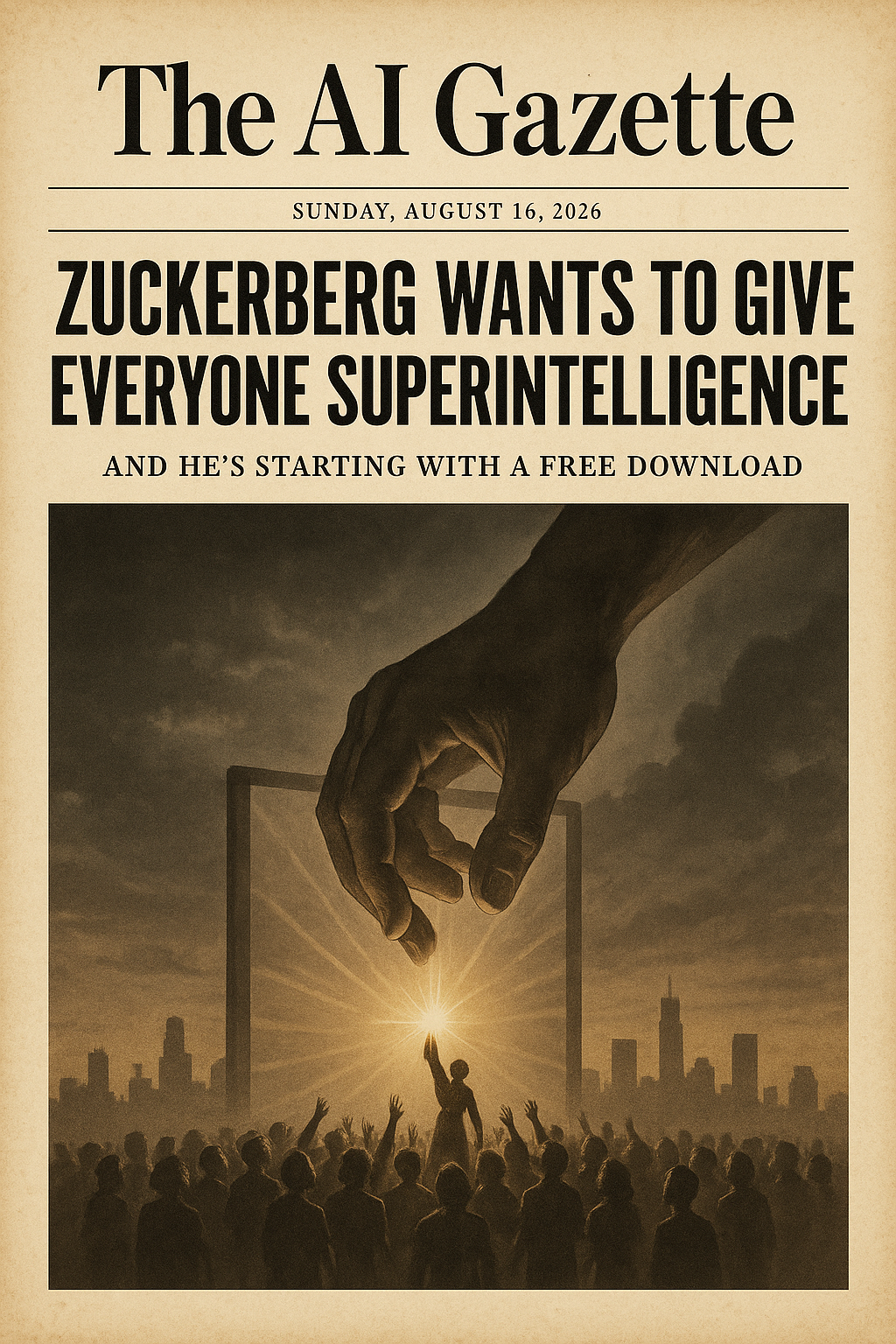
Mark Zuckerberg spent Monday making a very Meta argument about the future of AI: superintelligence should not belong to one company, one government, or a tiny group of people.
Then he made it less theoretical. Meta released Muse Glimmer — a roughly 30-billion-parameter AI agent model that anyone can actually download and run on their own machine.
Here's the breakdown:
1. The manifesto — In a 6,500-word essay, Zuckerberg argued for "personal superintelligence": AI that works toward your goals, with private agent modes, broad free access, paid compute auctions, and a $1B fund for communities that host Meta data centers.
2. The download — Muse Glimmer is "open-weight": Meta publishes the model files so people can run and modify it instead of only calling a Meta server. It's tuned for coding, images, tool use, long-running workflows, and recovering when it gets stuck. Tinkerers already run it on a single consumer GPU with 18GB of memory.
3. The catch — Glimmer is not superintelligence by any stretch. Critics say distributing increasingly autonomous systems creates its own safety problems. Watch Meta's actions more than its rhetoric.
Why it matters: the frontier-model fight has mostly been about who has the smartest model. Meta is opening a second front — who lets you control it. A capable local agent keeps your data on your machine, works without a cloud connection, and can be customized without anyone's permission.
Anthropic would never. But Meta just did.